
My paper is out in Current Biology! Group-level phenotypes are idiosyncratic yet unpredictable over development in a clonal fish. The title is a bit of a mouthful, so let’s break it down, there’s a lot going on here.
The fundamental question is “Where do group-level differences come from?” For individuals, we have this notion of nature (genetics) vs nurture (environment). The genetics and environment obvious come into play in groups, but differences might also be due to group composition (the number of behavior of individuals in the group) and/or group interactions (all the complex social interactions that occur within groups). Just as individuals tend to be distinct (showing “personality”), groups also tend to be unique (sometimes called “culture”), but it’s hard to get at where these differences come, just because studying groups necessarily takes more time and space than studying individuals.
To get at this, we created 10 replicate groups of day-old naturally clonal Amazon Mollies and monitored their behavior throughout their lives. This lets us control genetics, group composition, and environment, while monitoring social interactions, to really identify how and when differences emerge. So, what did we find?
First, it turns out baby mollies don’t really want anything to do with another. For the first 3 weeks of life, their behavior is statistically unrelated to their group mates. They just swim around, doing their own thing.
Then around day 24, something changes, and they start sticking together. (My guess is what changes is that they are no longer small enough to be gobbled up by a passing molly of average size, so it’s a good time to start making friends, but maybe there are developmental constraints on sociality that prevent cohesion earlier). In any case, over these first few weeks, groups are reasonably predictable over time, but once they start interacting properly, this all goes out the window. This means that we can’t predict what a group will be at 2 months, based on who they are in their first 2 weeks.
Maybe this doesn’t seem that surprising to you, but it’s actually completely different from what we see in isolated individuals, who are basically locked in from birth (e.g., the fastest individuals stay the fastest). We did a simulation to show that if individuals kept the same consistency we observe when they’re in isolation, group-level averages would be highly predictable, but that’s not what we observe. Rather, the complexity of group interactions seems to overrule the consistency of individual behavior to create group-level developmental patterns that are highly unpredictable over longer timescales. In other words, your social groups are distinct, but they might behave completely different two months from now, and it may be impossible to predict what that change is going to be. Super cool stuff.
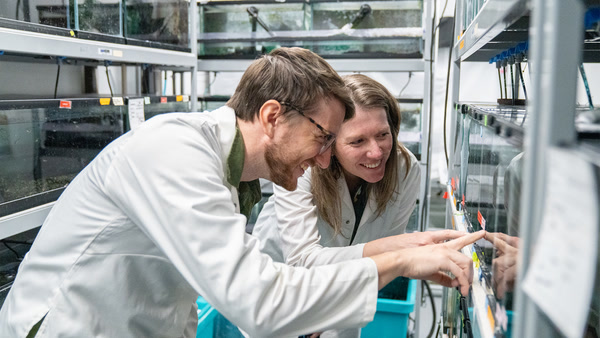
We actually got a little profile by the UC Davis media. They do a nice summary of the paper, but the very best part was doing stereotypical scientist photos for the photographer. Luckily, as real scientists, we wear lab coats and point at things all the time. You can check that out here: https://biology.ucdavis.edu/news/how-being-social-shapes-school-fish
This project was a blast. It was a collaboration with several other great scientists, and I got brought in at the back end to do the analysis and writing. Remember, as the holiday season approaches, there’s no better present for the data scientist in your life than a big high quality dataset waiting to be analyzed.
~ap